
Why Loft Conversions and Home Extensions Are Smart Investments

Updated: Jun 2
The Benefits of Loft Conversions
A loft conversion is one of the most cost-effective ways to add extra living space without extending your home’s footprint. Whether used as a bedroom, office, or master suite, it transforms unused attic space into functional living areas.
Key Advantages:
Adds usable square footage without reducing garden space.
Often falls under permitted development, meaning no full planning permission is required in many cases.
Faster and less disruptive than moving house.
High demand feature for future buyers.
Value Added:
In many UK regions, a loft conversion can increase property value by approximately 15%–25%, depending on quality and location.
Home Extensions: Expanding Your Living Space
Home extensions—such as rear, side-return, or wraparound builds—are ideal for improving family living space and modernising older properties.

Key Advantages:
Creates larger kitchen, dining, and living areas.
Improves natural light and flow.
Ideal for growing families or multi-use spaces.
Strong buyer appeal in competitive markets.
Value Added:
A well-designed extension typically adds 10%–20%+ to property value, with higher gains in high-demand areas such as London and the South East.
The Financial Reality: Why Moving Often Costs More
While moving may seem like a simple solution, the financial costs are often underestimated.
Major Costs of Moving Include:
Stamp Duty Land Tax (SDLT).
Estate agent fees.
Solicitor and conveyancing costs.
Surveys and mortgage arrangement fees.
Removal services.
Higher mortgage rates on a more expensive home.
You can review official stamp duty thresholds and costs here: UK Government Stamp Duty Land Tax Guide.

Depending on property value, stamp duty alone can run into tens of thousands of pounds. For example, the UK Government outlines that higher-value properties incur progressively larger SDLT charges, making moving significantly more expensive than many homeowners expect.
Rising House Prices Make Staying Put More Attractive
House price growth trends continue to increase the cost of upsizing. Recent data from the UK housing market shows long-term growth, even with short-term fluctuations:
Nationwide House Price Index: Nationwide House Price Index.
Halifax House Price Index: Halifax House Price Index.
These reports consistently show that buying a larger home often requires a significant step up in price, especially when moving within the same area.
The Cost vs Value Equation
When comparing options, homeowners should think in terms of net financial impact.

Moving House:
High upfront transaction costs.
Increased mortgage debt.
Repeated costs every time you move.
No return on money spent (fees are “lost costs”).
Loft Conversion / Extension:
One-time investment.
Adds permanent value to your property.
Increases equity.
Improves lifestyle immediately.
According to UK property experts such as the HomeOwners Alliance: HomeOwners Alliance Property Advice, well-planned renovations can often deliver better long-term value than moving, particularly in high-cost areas.
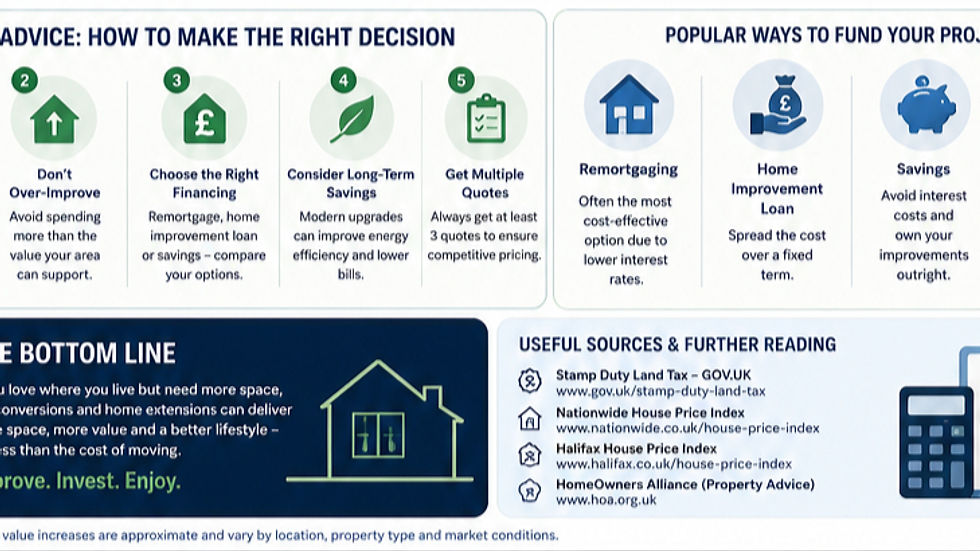
Financial Advice: How to Make the Right Decision
If you’re considering a loft conversion or extension, here are some practical financial tips:
1. Compare Cost vs Added Value
A typical loft conversion might cost £40,000–£70,000, but could add significantly more in resale value depending on location. Always compare:
Build cost.
Expected property value increase.
Local market demand.
2. Don’t Over-improve Your Property
Not every upgrade guarantees full return. In lower-value areas, it’s possible to “overbuild,” where extension costs exceed the added value.
3. Consider Financing Options Carefully
Common funding routes include:
Remortgaging (often the cheapest option due to mortgage rates).
Home improvement loans.
Savings (if available, avoids interest costs).
4. Factor in Long-term Energy Savings
Modern extensions often improve insulation and energy efficiency, which can reduce long-term household bills.
5. Get Multiple Builder Quotes
Costs vary significantly. Getting at least three quotes helps ensure realistic pricing and avoids overpaying.
Why Improving Beats Moving in 2026
With inflationary pressure on construction and property prices remaining high, improving your existing home offers several key advantages:
Avoids stamp duty and moving costs.
Builds equity in your current property.
Creates a home tailored to your needs.
Reduces disruption compared to relocating.
Often delivers a stronger long-term financial outcome.
Final Thoughts
Loft conversions and home extensions are no longer just lifestyle upgrades—they are strategic financial decisions. In many cases, improving your current home is significantly more cost-effective than moving, while also increasing both comfort and long-term value.
If you love your location but need more space, the smartest move might be staying exactly where you are—and building upwards or outwards instead.


Comments